
Mirrored Sliding Doors: The Product Category Distributors Should Be Stocking in 2026
Sourcing guide for distributors and importers
Mirrored Sliding Doors: The Product Category Distributors Should Be Stocking in 2026
Interior door demand is shifting. Across 2026 design coverage, the heavy rustic barn door look is increasingly described as dated, while glass and mirrored sliding doors are highlighted as the direction buyers now prefer. For distributors and importers, that shift changes which SKUs move, which inquiries convert, and which products deserve warehouse space.
A mirrored sliding door sits in an unusual position in the category. It works as a door, a full-length mirror, and a light-reflecting surface at the same time. That combination is why it performs well in apartments, wardrobes, hallways, and compact rooms where a swing door and a separate mirror would both compete for space.
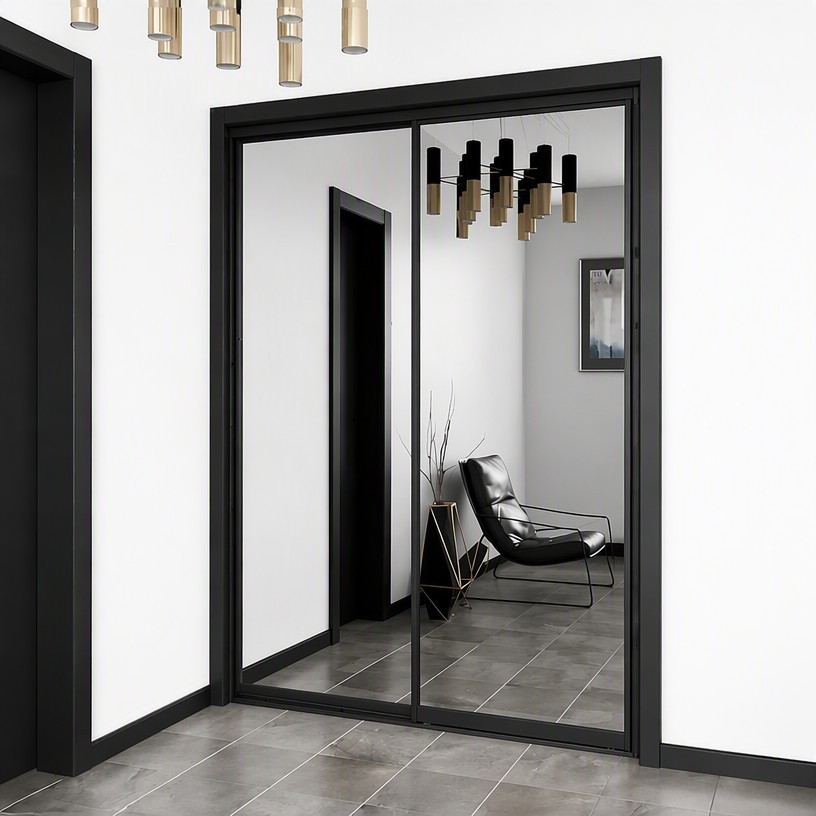
Why this category is gaining share
Traditional barn doors solved one problem: saving swing clearance. Mirrored sliding doors solve three at once.
- Space efficiency. No swing arc is required, so floor area stays usable.
- Perceived room size. A full-height reflective surface visually extends narrow hallways and small bedrooms.
- Functional replacement. The door itself replaces a separate wall or floor mirror.
For a distributor, this matters commercially. A product that answers several needs at once is easier to position, easier to justify at a higher price point, and less dependent on a single design trend cycle.
Where demand concentrates
Closet and wardrobe applications are the most consistent volume driver, because that is where end users most want a mirror anyway. Hallway and room-divider applications follow, usually with more attention paid to frame color and edge detailing.
Safety comes before styling
Mirrored doors raise one predictable objection from every serious buyer: what happens if the mirror is broken?
Direct answer: the doors covered in this guide use tempered glass with a safety backing film, so the panel construction addresses both impact behaviour and fragment control.
Tempered glass
Tempering changes how the glass behaves under impact compared with ordinary annealed mirror glass.
Safety backing film
The film is bonded to the rear of the mirror and is designed to hold fragments in place rather than letting them scatter freely.
This specification should be confirmed against the requirements of each destination market before ordering. Local building codes, certification requirements, and project specifications vary by country, and any formal testing or documentation requirements should be agreed before production rather than assumed.
For distributors, the practical takeaway is straightforward. A mirrored door without a stated safety construction is a liability in a catalog. A mirrored door with a clearly described construction is far easier to sell into residential and rental projects.
Frame, finish, and the visual result
The frame does more work than most buyers expect. It defines the visual style, protects the mirror edge, and carries the sliding mechanism.
These doors use an aluminum alloy frame, which keeps the profile slim while remaining stable across a full-height panel. Slim framing matters here. A heavy frame breaks the reflective surface and makes the door look like furniture rather than architecture.
Frame color is fully customizable, so finishes can be aligned with regional taste rather than a single standard option. In practice, this is one of the strongest arguments for sourcing directly from the manufacturer instead of buying from a generic catalog.
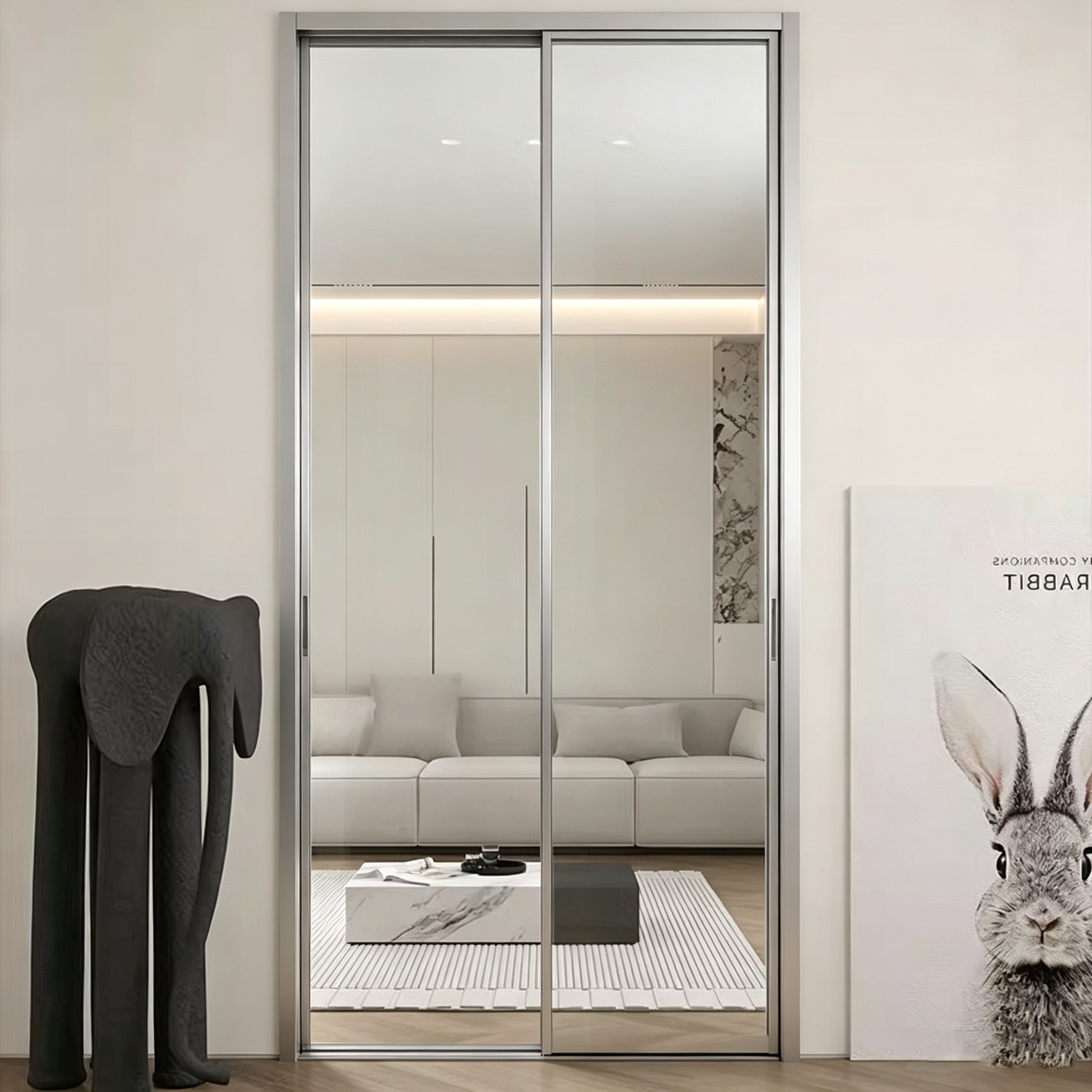
Two finish directions buyers request most
| Finish direction | Visual effect | Typical pairing |
|---|---|---|
| Matte black framing | Strong graphic contrast against white walls | Black lighting fixtures, dark door casings, darker flooring |
| Silver and brushed metallic framing | Frame recedes so the mirror surface leads | Minimal wardrobe walls, pale wood floors, neutral palettes |
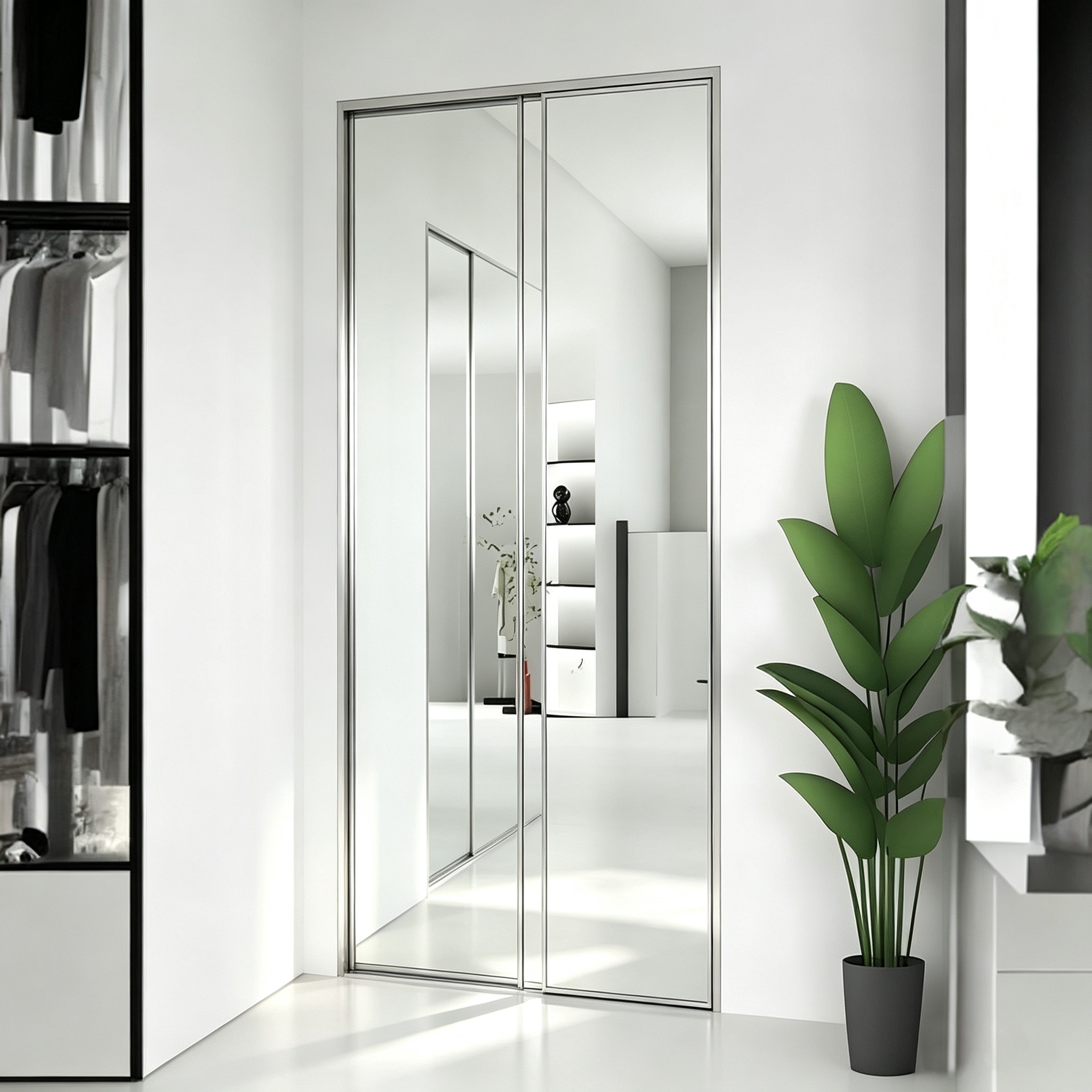
Concealed top and bottom track systems
These doors run on a concealed top and bottom track system rather than exposed overhead barn door rails. The difference is significant for this category.
- Hardware stays visually quiet, keeping attention on the mirror surface.
- The bottom track helps control lateral movement of a heavy reflective panel.
- The installation reads as built-in rather than surface-mounted.
Exposed rustic rail hardware works when the door is meant to be a statement in wood or steel. It works against a mirrored door, where the intent is a clean, uninterrupted reflective plane.
What distributors should evaluate before stocking
- 01Application mix. Wardrobe, closet, hallway, or room divider, each with different size expectations.
- 02Standard opening sizes in your target market, including whether metric or imperial dimensions dominate.
- 03Panel configuration. Single sliding panel, two-panel bypass, or multi-panel wardrobe runs.
- 04Frame finish demand across your customer base, and how many finishes you realistically need to hold.
- 05Safety expectations and any documentation requested by customers or local regulations.
- 06Packaging and transport protection, since mirrored panels require careful handling.
- 07Replacement part availability for tracks and hardware components.
- 08Sample requirements before a first bulk order.
Answering these before requesting a quotation shortens the sourcing cycle and produces a far more accurate proposal.
Customization and supply support
Mirrored sliding doors rarely fit a single standard configuration across markets, which is why customization matters more here than in commodity door categories. Available directions include dimensional and structural customization, frame color and surface finish customization, OEM and ODM cooperation for distributors building their own brand line, sample development before volume production, and batch order support after specifications are approved.
Final specifications should always be based on confirmed project data rather than assumed standards. Where a market requires specific documentation, testing, or compliance evidence, that requirement should be raised at the quotation stage.
Frequently asked sourcing questions
Are mirrored sliding doors suitable for rental properties?
They are commonly used in rental and residential projects, provided the panel construction and installation method are reviewed against local requirements for the destination market.
Can the frame finish be matched to an existing product line?
Frame color is fully customizable, so finishes can be aligned with an existing catalog rather than limited to a fixed standard option.
What information speeds up a quotation?
Target markets, common opening sizes, preferred frame finishes, panel configurations, and expected order volume are the inputs that most affect the recommended configuration.
Closing summary
Mirrored sliding doors combine space saving, visual expansion, and mirror function in one product, which is why the category is holding attention while rustic barn door styling cools. For distributors, the decision comes down to panel safety construction, frame finish flexibility, track type, and how well the supplier can adapt sizes to the target market.
To discuss a program in more detail, share your requirements through our contact page, or continue reading related articles in our blog.